The Hollow Jug
by Muntadar Alshaikh
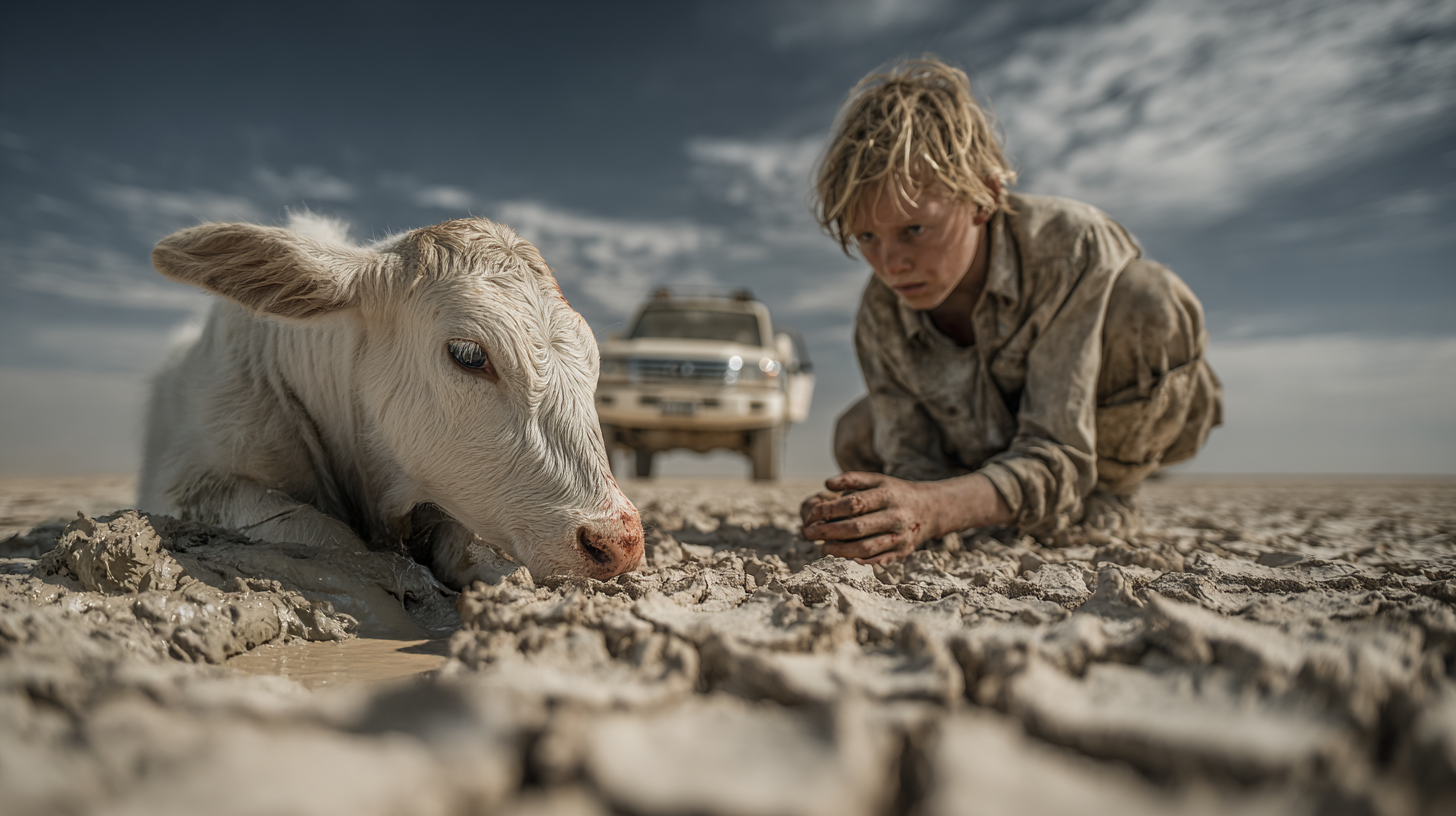
The Land Cruiser rattled as it dropped into the dry bed of North Dam. Dust pushed in through the vents no matter how Arthur set them. The AC had been dead for two summers. He swallowed, tasting grit.
“Keep your window up,” he said. Leo didn’t. He watched the cracked mud stretch out like broken plates.
They saw the calf late—just a twitch in the basin. By the time Arthur braked, the engine ticked in the heat. “Don’t,” Arthur said. “Mud’ll hold you. We haven’t got the fuel to play heroes.”
Leo was already out, boots sliding on the crust. He went down the bank and onto the grey, each step leaving a dark print that seeped back in slowly.
Arthur swore, killed the engine, and counted—one, two, three—watching the boy kneel and dig with his hands. The calf was sunk to the ribs. Its sides shuddered. Its nostrils were packed solid with clay.
“Leo! It’s done. You’ll break your hands for nothing.” Leo didn’t look up. “It’s breathing.” “Not for long.” Arthur looked at the fuel gauge. Just under a quarter. The homestead was two hours if the road held. Out here, you didn’t spend fuel twice.
He opened the door anyway. The heat hit like a wall. By the time he reached the boy, Leo’s fingers were bleeding where the clay had cut them.
“Move.” “I’ve got it.” “You don’t.” Arthur forced the tow rope under the calf’s chest. “On three.” They pulled. The mud held, then gave with a wet, ugly sound that made Leo flinch. They dragged the calf onto drier crust where it lay, legs useless, head twisted.
It tried to breathe. Nothing went in. Leo dropped beside it, scraping at the nose. The clay was already hardening. “It’s choking.” The insulated jug sat on the passenger floor. Three litres—maybe less. Enough for the drive back if nothing went wrong. Out here, water wasn’t comfort. It was survival.
“Leave it,” Arthur said, quieter now. “We’ve done enough.” Leo didn’t stop. “We haven’t.” Leo reached for the jug first. Arthur turned fast. “No.”
“Just a bit.” “Think,” Arthur said. “You pour that, and we drive home dry. You understand what that means?” Leo swallowed—a dry click, nothing more. “I understand this,” he said, and tilted the jug. Arthur grabbed the base, stopping the flow. Water sloshed, loud in the quiet.
Leo looked at him—still, certain. He twisted free. The first spill hit the calf’s nose and vanished into dust. The second reached its mouth. The tongue moved. The scent rose—wet copper and old dust.
Arthur wrenched the jug away—harder than he meant to. Leo’s hands dropped, bleeding and packed with clay, but his stare didn’t waver. Arthur stared at those hands. They were shaking. He felt the sandpaper rasp in his own throat.
He hesitated. Not long. Enough. He poured. Not carefully. Not nobly. He poured like a man trying to end something. Water ran over the snout. He scrubbed until pink showed and the calf jerked, dragging in a wet, broken breath. Another.
Arthur tipped the last into his palm and pushed it to the mouth. It swallowed, small and greedy. The jug went light. He let it fall. It hit the truck bed with a hollow knock that carried. No one spoke.
Arthur felt the first dull throb of a dehydration headache behind his eyes. “Right,” Arthur said. “That’s that.” They climbed back in. Leo shut his door softly, like there was something inside that might break. The engine caught.
In the mirror, the calf got one leg under itself. Then another. It stood badly, but it stood. Arthur drove.
Ten minutes out, Leo licked his lips and tasted nothing. He watched the road unspool through heat that bent the horizon.
“Dad,” he said, and stopped. Arthur kept his eyes on the track. “What?” Leo looked at his hands. The cuts were packed with dry clay again.
“Nothing.”
The empty jug rolled once in the back and came to rest. Arthur drove a little slower than he needed to.
Muntadar Alshaikh writes sparse, character-driven fiction that examines human endurance and moral restraint in unforgiving landscapes. His work relies on physical tension and silence to navigate complex emotional terrain. 'The Hollow Jug' is his debut award-winning story.